「英中对照」Willow基于QUDT开源标准实现建筑运营数据单位管理
Managing Units with Willow
Willow基于QUDT开源标准构建单位管理引擎,解决建筑内多厂商设备及暖通、照明等子系统计量单位不统一问题。该引擎可在数据接入环节标注单位,支持标准化存储、即时转换,能输出适配公制、英制的运营报表。其可支撑能耗、舒适度等楼宇运营KPI计算,支持用户选择偏好计量单位。
In the modern world of building management, data is the currency of operational excellence. Raw sensor values, thresholds, setpoints, and insights all flow through a digital environment powered by IoT and analytics. The value of this data hinges not just on its accuracy, but also on its context, and especially its units of measurement. 在现代楼宇管理领域,数据是卓越运营的“货币”。原始传感器数值、阈值、设定值和洞察都在由物联网与分析技术驱动的数字环境中流动。这些数据的价值不仅取决于其准确性,还取决于其上下文,尤其是计量单位。
The Importance of Managing Units计量单位管理的重要性
With a robust strategy for unit management, organizations get ahead of challenges with sensor readings and erroneous calculations. In modern buildings, devices and systems come from a myriad of manufacturers, each with their own native units. Subsystems such as HVAC, refrigeration, lighting, and access control may use different conventions within the same building. The resulting mix of units such as PSI and kPa, °F and °C, or ft/s and m/s can lead to a data ‘Tower of Babel’ if not carefully managed. Accurate conversions, normalization, and labeling are essential for data integrity. This is particularly important when aggregating and automating building performance metrics and insights worldwide. 借助稳健的单位管理策略,企业可以提前应对传感器读数和错误计算带来的挑战。 在现代建筑中,设备和系统来自众多制造商,每个制造商都有各自的原生单位。同一栋建筑内,暖通空调、制冷、照明和门禁控制等子系统可能采用不同的惯例。若不谨慎管理,PSI 与 kPa、°F 与 °C、ft/s 与 m/s 等单位混用,就可能导致数据“巴别塔”问题。准确的换算、归一化和标注对数据完整性至关重要。在全球范围内汇总建筑性能指标与洞察并实现自动化时,这一点尤为重要。
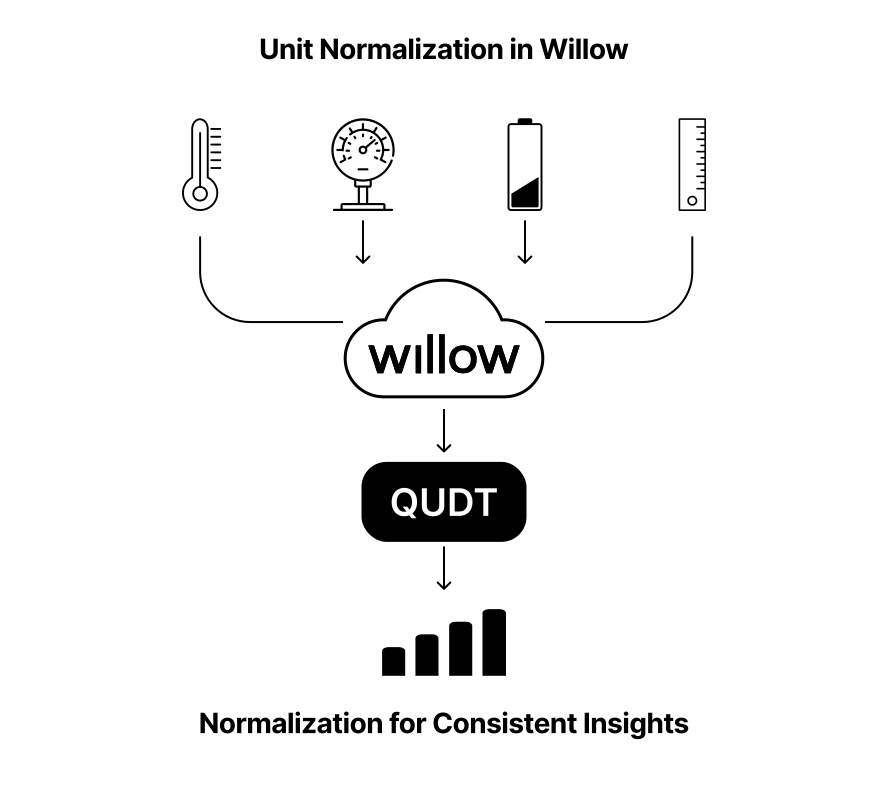
It is within this context that Willow built a unit management engine to normalize units leveraging QUDT (Quantities, Units, Dimensions, and Data Types), an open standard providing a comprehensive ontology for quantities and their possible units. This enables a scalable framework for all analytics. As a result, organizations can normalize and convert units unambiguously across workflows.正是在这一背景下,Willow 利用 QUDT(Quantities, Units, Dimensions, and Data Types,即量、单位、维度和数据类型)构建了单位管理引擎,以实现单位归一化。QUDT 是一项开放标准,为量及其可能采用的单位提供了全面的本体。这为所有分析工作提供了可扩展的框架。因此,企业能够跨工作流明确无误地归一化和换算单位。
QUDT: The Foundation for Modern Unit ManagementQUDT:现代单位管理的基础
QUDT is an internationally recognized open-source knowledge base for representing units of measure and physical quantities. It was first developed for the NASA Exploration Initiatives Ontology Models (NExIOM) project at Ames Research Center. It has since evolved into a public, open-source resource maintained by a board of directors from multiple organizations as QUDT.org.QUDT 是一个国际认可的开源知识库,用于表示计量单位和物理量。它最初是为艾姆斯研究中心的 NASA Exploration Initiatives Ontology Models (NExIOM) 项目开发的。此后,它发展为一个公开的开源资源,由来自多个组织的董事会作为 QUDT.org. 进行维护。
This standard defines thousands of units and dimensional relationships. The extensive taxonomy covers standard, derived, and custom units used in industry. By referencing QUDT, platforms like Willow gain a universal mechanism for describing the value, precise unit, physical dimension and transformation rules.该标准定义了数千种单位和维度关系。其广泛的分类体系涵盖工业领域使用的标准单位、导出单位和自定义单位。通过引用 QUDT,Willow 等平台获得了一种通用机制,用于描述数值、精确单位、物理维度和转换规则。
Willow’s ApproachWillow 的方法
- Unit Normalization: Telemetry sources may produce values in various units. Willow uses QUDT identifiers, also known as URIs, to tag each value with its source unit and quantity kind.单位归一化:遥测源可能产生以各种单位表示的数值。Willow 使用 QUDT 标识符(也称为 URI)为每个数值标记其源单位和数量类型。
- Standardized Storage: All data in Willow is stored with an associated QUDT reference, so that downstream analytics always have access to the explicit unit details.标准化存储:Willow 中的所有数据在存储时都带有相关的 QUDT 引用,因此下游分析始终能够获取明确的单位详细信息。
- On-the-fly Conversion: QUDT’s classification provides the structure for the Willow to carry out conversions to match the input values or the customers defined preference.即时换算:QUDT 的分类为 Willow 提供了执行换算所需的结构,以匹配输入数值或客户定义的偏好。
- Interoperable Reporting: Through QUDT, Willow normalizes unit symbols, ensuring that all stakeholders, whether using metric or imperial, can receive clear figures.互操作报告:Willow 通过 QUDT 归一化单位符号,确保所有利益相关方无论使用公制还是英制,都能收到清晰的数字。
The End-to-End Process端到端流程
Let’s walk through the process of how unit management works in Willow as data is normalized and processed in Skills to generate Insights.下面我们来梳理 Willow 中单位管理的运作流程:数据在 Skills 中经过归一化和处理,以生成 Insights。
-
- Source Data Collection and Tagging
Willow ingests telemetry and metadata from a wide variety of sources, spanning Building Management Systems, IoT devices, meters, and more. Willow’s architecture includes Mapped, an industry-leading connectivity and data management platform. Our deep partnership enables customers to achieve value immediately through a consolidated platform, communicating with the source systems on the Edge and in the Cloud. Each data point received is accompanied by metadata specifying its origin and, crucially, its unit of measure. For devices using open protocols such as BACnet, Modbus, OPC UA, units are parsed from the configuration or raw data stream. Proprietary integrations may require a mapping process to assign the correct unit based on manufacturer documentation. Every quantity is a value paired with an explicit unit code, such as QUDT’s KilowattHour or Degree_Celsius. This pairing is stored from point-of-ingest, allowing the full data lineage and facilitating traceability.源数据采集与标注
Willow 从各类来源摄取遥测数据和元数据,涵盖楼宇管理系统、物联网设备、仪表等。Willow 的架构包括 Mapped,这是一个行业领先的连接与数据管理平台。我们的深度合作伙伴关系使客户能够通过一个整合平台立即实现价值,该平台在边缘侧和云端与源系统通信。接收到的每个数据点都附有元数据,用于说明其来源,以及至关重要的计量单位。对于使用 BACnet、Modbus、OPC UA 等开放协议的设备,单位会从配置或原始数据流中解析。专有集成可能需要执行映射流程,以根据制造商文档分配正确的单位。每个数量都由一个值与一个显式单位代码配对组成,例如 QUDT 的 KilowattHour 或 Degree_Celsius。这种配对从摄取点开始存储,从而支持完整的数据血缘并便于追溯。 - Digital Twin Modeling and Annotation
Willow models each asset and telemetry point in its ontology to support different systems of units. For example, the Supply Air Temperature of an Air Handling Unit is annotated as a temperature, with the system capable of handling both °F and °C as incoming data units. If a control point is migrated from one system to another or replaced with a new sensor, Willow’s QUDT-backed schema prevents errors from the moment data enters the system through all downstream computation.数字孪生建模与标注
Willow 在其本体中对每项资产和遥测点进行建模,以支持不同的单位制。例如,空气处理机组的送风温度被标注为温度,系统能够将 °F 和 °C 同时作为传入数据单位处理。如果某个控制点从一个系统迁移到另一个系统,或被更换为新的传感器,Willow 基于 QUDT 的架构会从数据进入系统的那一刻起,贯穿所有下游计算,防止错误发生。 - Unit Conversion Logic and QUDT Mappings
Whenever data is analyzed, Willow uses the QUDT conversion framework to ensure consistency. For basic units, this may involve multiplying by a factor, such as converting gallons to liters, or including an offset, such as converting °F to °C. These mappings are sourced from the QUDT ontology. This approach is scalable and robust against human error.单位换算逻辑与 QUDT 映射
每当分析数据时,Willow 都会使用 QUDT 换算框架来确保一致性。对于基本单位,这可能包括乘以一个系数,例如将加仑换算为升;或加入一个偏移量,例如将 °F 换算为 °C。这些映射源自 QUDT 本体。该方法具备可扩展性,并能可靠防范人为错误。 - Analytics, Insights, and KPIs
When calculating KPIs or benchmarks, Willow’s Activate Technology leverages QUDT to ensure that calculated values remain meaningful. For example, summing electric consumption from devices reporting in kWh and MWh is seamless, as all values are normalized to a standard base unit to report the annualized Energy Unit Intensity in kBtu/ft2 . Similarly, Comfort Score in Willow is computed by normalizing Zone Air Temperature and setpoints before calculating the percentage of times temperature remains within range over a period of time.分析、洞察与 KPI
在计算 KPI 或基准时,Willow 的 Activate Technology 会利用 QUDT 确保计算值保持实际意义。例如,将以 kWh 和 MWh 报告的设备用电量相加非常顺畅,因为所有值都会被归一化到一个标准基本单位,从而以 kBtu/ft2 报告年化能源单位强度。类似地,Willow 的舒适度评分会先对区域空气温度和设定值进行归一化,然后计算一段时间内温度保持在范围内的时间百分比。 - User Experience and Preferences
Willow allows selection of preferred units for a range of measurable quantities. Defaults such as °C vs. °F can be specified through App Preferences at a user level. All displays, trend charts, and exports convert and present values in the selected units, leveraging the QUDT-backed logic. This preference mapping extends to multi-national portfolios, where teams in different regions see data in locally relevant units while analysis and data science functions can work in SI base units for consistency.用户体验与偏好
Willow 允许为一系列可测量选择首选单位。°C 与 °F 等默认值可在用户级别通过应用偏好设置指定。所有显示、趋势图和导出都会利用基于 QUDT 的逻辑,按所选单位换算并呈现数值。这种偏好映射适用于跨国资产组合:不同地区的团队可以查看符合当地使用习惯的单位数据,而分析和数据科学职能则可使用 SI 基本单位以保持一致性。
- Source Data Collection and Tagging
Closing Thoughts 结语
By standardizing to the QUDT system and creating a robust conversion engine, Willow delivers trusted analytics built on a foundation of normalized data. KPI reporting is consistent and accurate. Global deployments are seamless for customers with international locations, with support for both metric and imperial conventions. Vendor and hardware interoperability is ensured by integrating a myriad of data sources, regardless of native units. Willow continues to update its QUDT vocabulary and conversion routines as new units, sensor types, and standards emerge.通过标准化采用 QUDT 系统并构建可靠的转换引擎,Willow 提供建立在归一化数据基础之上的可信分析。KPI 报告保持一致且准确。对于拥有国际站点的客户,全球部署无缝顺畅,并同时支持公制和英制惯例。通过集成众多数据源,无论其原生单位为何,均可确保供应商与硬件的互操作性。随着新单位、传感器类型和标准的出现,Willow 持续更新其 QUDT 词汇表和转换例程。
Powered by QUDT, Willow ensures that the platform is consistent for digital transformation of facilities and infrastructure. This approach supports Willow’s vision as a unified, trustworthy single source of truth for the entire building, campus, or portfolio, unlocking optimal operation, energy savings, and data-driven decision-making.借助 QUDT,Willow 确保平台在设施和基础设施的数字化转型中保持一致性。该方法支持 Willow 的愿景,即成为整栋建筑、园区或资产组合统一、可信的唯一事实来源,从而实现最佳运营、节能和数据驱动决策。
The post Managing Units with Willow appeared first on Willow.文章 使用 Willow 管理单位 首次发布于 Willow。
来源:Willow 建筑运营与数字孪生 · willowinc.com